Showing posts with label ironclads. Show all posts

Thursday, 19 January 2023

Back in the Saddle

 So after a rather muted start to the year I've got back in the saddle with some more 3D modelling (which I'm finding works quite well as therapy). I've actually put together around ten new 1/600 models in the last few weeks, but here are a few of the more unusual ones.

Mike Haught has released the "War of the Pacific" battlepack that Rolf Grein has been working on. When I met Rolf in Oz in November he was adamant that I should model HMS Shah and Amethyst as their battle with Husacar was included in the pack. Both were fun to model and Shah  proved to be the biggest model I've printed on my Elegoo Mars so far. Pictured here with an ACW ferryboat gunboat which I also worked up over Christmas.


In a similar vein I've modelled the Peruvian ironclads Victoria and Loa


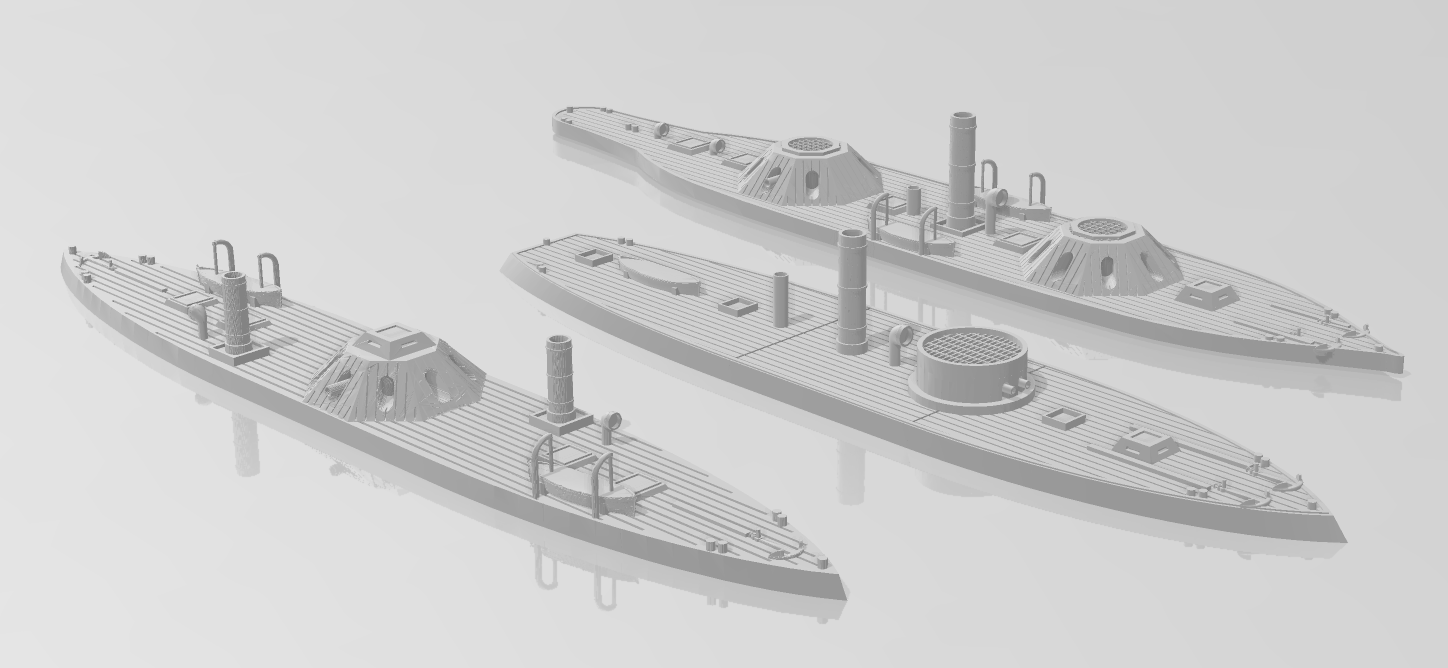
and a chance discussion on one of the naval wargaming Facebook groups got me interested in some of the proposed and uncompleted Confederate ironclads (a good counter to all the monitors I've been working on recently - more on those in a later post)

All good fun to work with, and now I'm looking at a range of less well known Confederate ironclads to model over the next few weeks.

Wednesday, 11 April 2018

Dahlgren and Columbiad

My latest set of quick play naval rules have hit the streets - or at least the servers at Wargame Vault. "Dahlgren and Columbiad" is a set of ironclad rules aimed at battles in the American Civil War and the ironclad wars in South America. It is aimed at games involving a small handful of ships and so it compliments "Broadside and Salvo" which was aimed more at fleet actions such as Lissa. It comes with a range of representative ship data for the ACW and South American wars


Dand C is supported by two theatre-specific booklets.

"By River and By Sea" covers the American Civil War in more detail, with two campaign systems and comprehensive ship data for over 175 ships and classes of the Union and Confederate navies.


"War of the Pacific" is something I've been working up to for decades and comprises a campaign system, ship data and brief campaign history covering the War of the Pacific, 1879-1883 between Chile, Peru and Bolivia, and also with my “Iron and Fire” more detailed rules from A&AGE. Ship data for the complete Peruvian and Chilean fleets is provided. Having visited Chile in 1994 and stood on the decks of the Peruvian / Chilean ironclad Huascar this is the culmination of over 20 years planning, and something I'm rather pleased and proud of :)


The third element of this project is the Paraguayan War, or the War of the triple Alliance, which again will feature a campaign system and comprehensive fleet data. This is all set to tie in with the excellent range of 1/1200 models from Spithead.

All three are available from Wargame Vault for a fiver. Links below if anyone is interested.


Monday, 1 August 2016

The Schleswig Holstein Question

My latest release from LFG is a supplement for "Broadside and Ram" entitled "The Schleswig Holstein Question". 

This supplement allows players of “Broadside and Ram” to extend their games to the Second Schleswig War, fought between Denmark and the allied Prussia and Austria in 1864, and also the Franco Prussian war of 1870 (although here the naval warfare element is conjectural). Summaries of the naval aspects of both conflicts is followed by ship data for all the major and minor warships involved. 


Additional data is provided for a selection of British, Dutch, Norwegian and Swedish ships of the era that could have been “on scene” and may form the basis for a hypothetical game. Finally a short set of additional rules covering sailing ships is included.

A copy of "Broadside and Ram" is required to use this supplement, which is available from Wargame Vault for $2.50

.http://www.wargamevault.com/product/187696/Broadside-and-Ram--The-Schleswig-Holstein-Question-supplement


Monday, 13 June 2016

Broadside and Ram

My latest publication is now available from Wargame Vault. "Broadside and Ram" is a set of fast play naval rules and a campaign system covering the Lissa campaign of 1866, which cerebrates its 150th anniversary next month.  It is based on my earlier "Ironclads in Action" supplement for "Iron and Fire" which was originally published by A&AGE but which has been out of print for many years. The tactical "DBA-esque" rules are based on the principles used in my "Lord of the Sea" rules updated for the more modern era, and the campaign system updated to reflect the use of the tactical rules. That said the campaign system should be adaptable to any set of ironclad rules.


The rules are available from the following link:
http://www.wargamevault.com/product/185447/Broadside-and-Ram?manufacturers_id=6867

Sunday, 5 February 2012

WW1 Oddities and Some SCW

I've been finishing off some odds and ends over the last few days. First up, some unusual French WW1 aircraft.


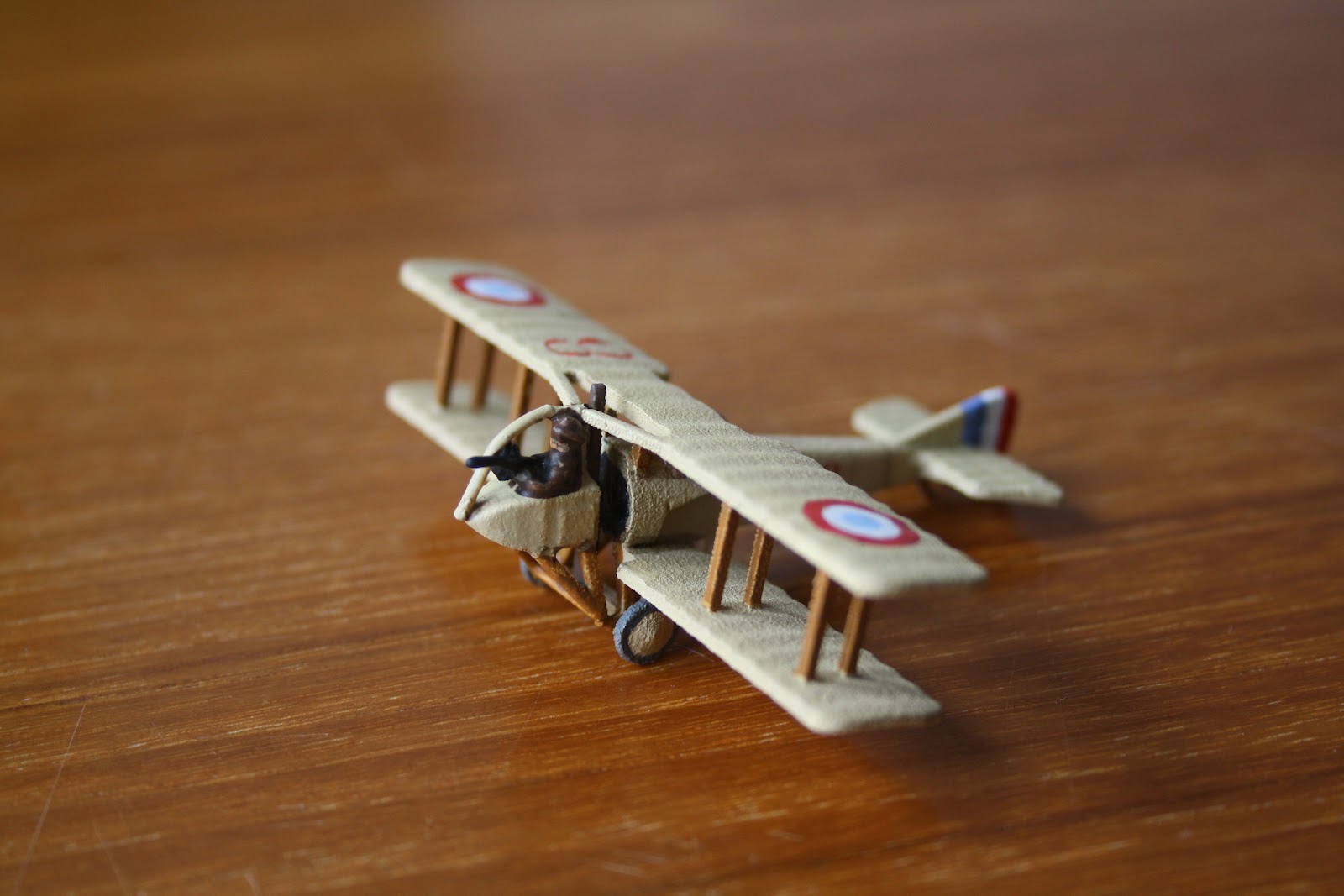
The big one is a Caudron G.4, an odd aircraft characterised by its enormous engines relative to the fuselage. I did this one in RNAS colours as (at the time of painting) I was fresh out of French roundels, and now that I have a new consignment from Dom's Decals it may get a change of ownership, but for now it gives my RNAS Tripes something to escort.


The smaller one is a Spad A.2. Even more of an oddity, this one is "mid engined" (but is no hot sports car). Instead, this was an attempt to solve the same gunnery problem that the British "pushers" managed, but solved by putting a gunner in a pod ahead of the engine (!). This is a lovely little model, to which I only added the guide rail for the nose gun (and a couple of pilot/gunner figures). 


I think if I was doing this one again I'd cut off the propeller and replace it an an angle, or replace it with a clear plastic disc to show off the real oddity of this aircraft. Otherwise its one of those things where you need to know what you are looking at to know what you are looking at, if you know what I mean :)

On the SCW front, some transport for my irregular units. On the left is an Ertl traction engine from the "Thomas the Tank Engine" series of toys (for those of a nervous disposition, I didn't file off his face; it is still there, hiding behind a disc of card. OK kids? move on). Now I don't know if they had traction engines like this in Spain, but I'm sure someone in the UK may have exported a few, and if not it will always do for my "imagi-nation" extension to the period.


The blue "technical" is a Zvezda ZIS-5 truck, augmented into a semi-armoured personnel carrier through the addition of card armour over the radiator, door sides and the cargo space. The cab windows are covered by brass mesh offcuts which I'm using for another project. 


Finally, a 1/600 Thoroughbred model of CSS Chicora, one of the Charleston squadron. The ship is often described as being painted pale blue, so I thought this would make an interetsing change from the normal black or light grey. 


A decent model and I don't really think the pictures do her justice. Now, the ACW is off my "to do" list for the year, but this model plus an impulse purchase (infrastructure rather than models or figures) might see this change in the next few weeks......

Anyway, currently on the workbench are some naval projects. More on these later :)

Monday, 29 August 2011

The Naval Wargames Weekend, Gosport

Liz, the kids and I have just returned from Gosport where we took part in the naval Wargames Weekend (organised jointly by the Naval Wargames Society and the Explosion! Museum of naval Firepower). We had a great time, and we hope the other attendees did too. There were a host of games presented over the weekend.

Stuart Barnes Watson staged a refight of the battle of Koh Chang in 1/1200. Some lovely, and quite rare, French and Thai models did battle amongst the islands and fog banks, with the French this time coming off distinctly second best.
Across from the Thai action, Battlegroup South had an awesome 1/700 Pacific War game with impressive models and terrain featuring a quiet Japanese anchorage that as about to receive the unwelcome attentions of the United States navy. This was a lovely game that earned many admiring comments during the two days.


As did the Solent Wargames Association’s “Sun, Sea and Sandwich” game, a 28mm Wars of the Roses naval game on Saturday. Many large cogs did regular battle, and several members of the public were co-opted in to command ships and to do their best for York or Lancaster.

The SWA changed games for Sunday and shifted forward in time and down in scale to cover famous surface actions of the Royal Navy in WW2, principally the sinking of the Bismarck and the Battle of the River Plate. General Quarters 3 rules were in use, and the games played with some lovely 1/2400 models.

Across the way Mark Barker’s “Inshore Squadron” put on an excellent demonstration game base don the 1811 battle of Lissa. Mark’s team always put on a  lovely show with some very fine models and this was no exception. Malcolm Smalley’s “Clear For Action” computer moderated rules were in use, and the action (at least on the first day) went true to form with a glorious victory for the Royal Navy (at least that’s what the RN commanders told me!)

Dave Sharp views the French and Venetian squadron, approaching its doom at the hands of the Royal Navy
NWS chairman Jeff Crane and family brought along a “Man o War” game, reminding players and public alike that naval wargaming isn’t restricted solely to historical genres. Alas Jeff was only able to stay for a short while, but it was good to see his MoW models in action again.


The next game on the list was an innovative recreation of WW2 damage control by Jim Wallman. In this game the players take on the role of Damage Control Officers on board HMS BELFAST, marshalling their scare resources in terms of equipment and manpower to fight fires, control and pump out flooding, limit damage and restore combat efficiency in an RN cruiser under fire. One of Jim’s participants was a serving RN officer who has done this kind of thing for real, and who said the whole thing had  a most realistic feel to it. Praise indeed!

Jim advises a member of the public on the intricacies of RN Damage Control

Wayne Pocock and Nathan Girdler planned to refight the battle of Hampton Roads in 1/600 using a variety of rules. I’m not sure how this turned out, but at the start of the day Monitor and Virginia were seen doing their best to cause damage by shot, shellfire and ramming using Jason Gorringe’s “Smoke on the Water” rules.

For my own part I had (overly) ambitious plans to run 4, possibly 5 different games over the weekend. In the end this didn’t quite work out. Saturday began with my “Wings and Waves of War” variant on the popular WW1 air combat game, wherein a brace of RN 55’ Coastal Motor Boats attempt to escape from German air attack. In the first game my CMBs successfully fought off a pair of Hansa Brandeberg W.29s; in the second action I took the Germans, now reinforced by a pair of Albatros W.4s. The RN force (commanded by Laura) was assisted by the arrival of an RNAS Camel. This time, despite sinking one of the CMBs by gunfire, my W.4s were savaged by fire from the boats (one going down to the dreaded “bang” card after suffering very little damage), whilst the Camel pounced on the W.29s. In the end the RN prevailed as my last W.29 was shot down, but not before the last surviving CMB had been heavily damaged.


Game #2 featured my “Privateer” game using 1/450 pirate ship models. This ended up as a static display, with plenty of discussion with passes by on the models, conversions and the rules.
Game #3, on Sunday morning, was the first run out of my rules covering Medieval small ship actions. The game was based on the battle of Sandwich (August 1217) in which an English squadron under deBurgh engaged a French force under Eustace the Monk. The rules worked well (although some areas for improvement were identified), and were certainly quick! Eustace once again succumbed to the onslaught of the English fleet, his flagship being surrounded and captured whilst other Englsish ships ransacked the French transports.


Game #4 was to have been my Cod War participation game, and game #5 the 1/600 model – and ground – scale recreation of the River Plate battle, but time did not permit these to come into play.

Overall the weekend went well. For a “first attempt” it was successful although as in all things we identified a number of areas where it could be better. The general consensus was that it was a worthwhile event that we will run again next year. Arranging the event at the same time as the Surface Warships Association’s display day at the museum was, on reflection, not wonderful as it meant the wargames were on display in the Grand Magazine – a lovely venue but very dark; ext time we will probably run the event on a  different weekend with games in the conference centre (which is large, light and airy). Moving away from the bank holiday weekend should also improve attendance, being more “family friendly” for potential participants (In fairness the location and date, and hence the non-availability of many NWS members and players was a result of the short timescales in organising the event).
So, in summary, a good weekend of gaming, and (for me at least) an excellent opportunity to catch up with old friends and to make new ones. Watch out for announcements about the event in 2012!


1/72 radio controlled “Flower” class corvettes, Surface Warship Association


Friday, 15 April 2011

Ozark and Arkansas

A couple of photos from last weekend's painting efforts. The latest additions to the colection are another pair of civil war ironclads. For the Union we have the river monitor Ozark, a not-entirely-successful design and a fairly curious design, combining a turret with a superstructure and exposed guns.

The second is the Confederate ironclad ram, Arkansas. One of my favourite civil war vessels on account of her rather splendid showing against a vast Union fleet (described by her captain as "a forest of masts and smokestacks), through which she passed with nary a scratch.

Both models come from Bay Area Yards and are very finely cast. The photos were taken in a hurry using one of our "point and shoot" cameras out in the garden in bright sunshine, so they don't really do justice to the models.

Also completed this week were a couple of Thoroughbred mortar schooners. Completed as far as the paintwork is concerned, I'm currently thinking about whether to rig them or not.


Currently on the workbench - two riverboat rams and the CSS Patrick Henry. More on these over the weekend.

Monday, 14 March 2011

This Weekend I Has Mostly..

... been working on an idea for a participation game that might be coming up in a few months. Its a naval game, but using Wings of War, so one side takes control of a couple of British 55' CMBs, the other side has  a pair of Hansa Brandenburg W.29s. I ordered the seaplanes from Riviresco a month or so back, and the CMBs arrived from Rod Langton on Saturday morning. As of now the planes are just about done, the boats undercoated and ready for a decent paint job. Details to follow in a few days when the project is complete.

Also on the stocks, in 1/600 I have the USS New Ironsides and a US paddlewheel gunboat to sort out (both from Thoroughbred), whilst in 20mm I've picke dup some decent desert stuff via Ebay, so there are a couple of Grants, Matildas, an '88 and tractor and a pair of Krupp protz trucks to spruce up.

No pics today though as the camera battery is flat and I forgot to recharge it.

Sunday, 27 February 2011

Wings of War, Hulls of Wood

Its been half term week here in Brizzle and, whilst looking after the kids I've also had  a chance to catch up with some modelling.

First up, my Wings of War collection. I got a couple of Nexus Dr.1 triplanes from Dom Skelton and they've been repainted in "personal" colours. One is a pink Dr.1 (Liz has a pink 74 gun ship fo the line and we have a pink Curtis P-40 Kitty Hawk, so why not a pink Triplane?), and the second is in the black and silver colours of "Der Schwarzen Hand", my Prussian dogfighting altar ego - prizes for anyone who works out why he goes by that nickname!)


Other repaints were an F Toys Albatros D.III in Richthofen's overall red scheme and a captured Sopwith Camel  painted up as the machine used by Kissenberth. I also finished a Riviresco Junkers D.1, and I was lucky enough to grab the two "secret" models for the F Toys Biplane Collection (Baracca's Spad VII and Goering's Albatros D.III) for peanuts from sellers in the Far East.


My other focus this week was my 1/600 ACW naval collection. I've had a pile of models from Thoroughbred and Bay Area Yards awaiting some attention for far too long. First up - my favourite ACW ship, USS Mississippi. A favourite for no other reason than my old Navwar model has a suitably downbeat yet hardworking appearance, and hence  alot of character and this, I think, translated well into the BAY model.


Also completed were a Thoroughbred Casco (torpedo boat version), Queen of the West, a Confederate Cottonclad, USS Essex, USS Galena, USS Rhode Island, the centre wheel Jefferson City (quite an unusual vessel) and couple of Maury gunboats (oh, and a pile of mortar rafts).


I've made a few of the BAY models now and, whilst the detail generally isn't quite as good as thoroughbred's they still make up into very nice models - plus they have tackled some very interesting subjects and complement the Thoroughbred range very nicely. its worth saying that I was, up until recently, very much a 1/1200 ACW naval gamer, but I've grown rather fond of the larger models. All in all a very busy week!

Monday, 27 December 2010

Warships of Salnaves War

In a variation to our normally Sudan-based programme, I've today posted a review of a rather excellent book that I mentioned in my blog from yesterday.


When one thinks of naval actions fought in the ironclad era one instantly thinks of the American Civil War, the Lissa campaign, and possibly the actions fought between Chile and Peru in the 1870s. Naval warfare off the coast of Haiti does not generally spring to mind. Yet, overlooked my many historians and naval enthusiasts, a vigorous naval campaign was a key element of the Haitian Civil War fought between 1867 and 1869. Often known as Salnave’s war, since it resolved the fate of President Sylvain Salnave, the naval actions were fought with a mixture of retired warships from the US Navy, combined with steamers and gunboats purchased from the UK and France.
Bill Warner has done an excellent job in researching and chronicling not only the ships involved in the war, but the war itself (and in this his book becomes one of only a handful of English language references to do so). The book starts with a general overview of Haiti’s history leading into the war itself, and the splitting of the country into three states (the Republic of Haiti, the Meridional Southern State and the republic of the North). The navies and ships of each state are described, the ships with an illustration, key particulars and a brief description of their service history, and the descriptions are supported by an additional chapter that details the armament of the ships. Battles are described in terms of their context in the broader war and the tactical aspects of the battle, supported with charts and contemporary illustrations where available. Finally there is a biography of Sylvain Salnave, notes on the frequent renaming of ships (invaluable since most of the ships had several owners and it can be tricky keeping track), a list of references and some suggestions for rules and models for wargamers.
This book and Dr Warner’s similar volume on the ships at Riachuelo have to be one of the key “finds” for naval enthusiasts and wargamers of 2010. This volume especially is extremely welcome in opening up a hitherto fairly well closed portion of Caribbean history. I would definitely recommend this to anyone with an interest in naval warfare in the era of the ironclad and gunboat.